Bending Spoons has announced buying Airtable for $1.285B in cash this week - which is less than the $1.4B in total funding Airtable has raised in the past, and well below the $11B valuation it had during its last fundraise in December 2021.
Selling to Bending Spoons is a company admitting defeat, and its inability or unwillingness to turn its business around, and wanting to get the highest possible cash for the business. Because this is what Bending Spoons is excellent at: they pay the highest cash value for a struggling business with a well-known brand, then take over operations, and operate the product with a fraction of the staff. They often let go most or all of the original team as they move over product operations to their in-house engineering team based in Italy and Europe.
Evernote: what happens when a new team takes over a legacy application
And having talked with Bending Spoons' engineering team on the podcast: they have done impressive engineering work after a takeover, in the past! For example, upon acquiring Evernote, the Bending Spoons engineering team discovered that the note-taking service was running as a Java 11 monolith (!!), with user data sharded across 750 manually provisioned virtual machines (!!!) on top of Google Cloud - in 2023! At a time when running cloud-native setups (managed databases, microservices) was common knowledge for years.
Evernote's existing setup was weirdly inefficient and operationally very heavy, with manual interventions needed to keep the service running. Needless to say, performance was poor because some VMs were regularly overloaded. Also, oncall was brutal!
The Bending Spoons engineering team rationalized the architecture:
- Migrated user data sharded from the 750 manually provisioned VMs to a managed database
- Split up the Java 11 monolith to microservices
- Did all of the above without disrupting user experience
- Improved performance of the backend by a wide margin
- Reduced oncall load after finishing the migration to a cloud-native setup vs the previous manual provisioning setup
- Did all the above in about 6 months.
It's a fair question: would long would have the original Evernote engineering team have taken to do the same changes that made the service more reliable, more performant, and cheaper to operate? I would guess it would have taken them many years: in fact, if they did not make this change until 2023, who knows if they would have ever made these pretty rational changes? And so the "shock therapy" of Bending Spoons starting with a blank page, and a new team taking over operating the full product, with a laser focus on efficiency: well, this approach can be pretty efficient, as the Evernote example shows.
You can listen to the full podcast episode I did with the Bending Spoons team: Twisting the rules of building software: Bending Spoons.
Price increases and the existing team let go: the two most typical complaints
Bending Spoons taking over an existing product has two major criticisms:
- Price increases. Evernote was the biggest example of price hikes: after Bending Spoons took over operating the product - and improving its performance - price hikes followed. Being Spoons kept investing in Evernote, adding new features (including AI ones), but customers paying $37/year for the Pro plan pre-2023 were charged $250/year by 2026. My take is that this is what happens when a product starts working a business maximizing profits: lots of customers will leave for competition, while others will pay more, valuing a more reliable service that gets more investment than before. Bending Spoons keeps improving Evernote since the acquisition, alongside the price increases. Clearly, the company is optimizing for maximizing revenue, not maximizing the number of customers, though.
- Layoffs. Bending Spoons let go most/all of the Evernote team in the US, briging operations in-house. This is part of the "usual" playbook of Bending Spoons: they buy products to operate them as efficiently as possible. The re-architecting example shows benefits of starting from scratch, and not needing to deal with internal resistance for changes that result in more efficient operations. Knowing that with a Bending Spoons acquisition, letting go of all the existing team is on the table is something that comes with selling to this company.
With this, let me share my analysis of a past Bending Spoons acquisition: when they bought SteamYard from Hopin.
Below is the now un-paywalled excerpt from The Pulse #89: The end of Hopin, from April 2024, sent to paid The Pragmatic Engineer subscribers. If you'd like to get analysis like this in your inbox, weekly, subscribe to The Pragmatic Engineer.
The End of Hopin
It’s been a real rollercoaster ride for the virtual events provider:
- 2019: founded with a mission to provide a solution for hosting virtual events.
- 2020-2021: raised a total of $1B in funding during a seed round in Feb 2020, Series A in June, Series B in November, and then a Series C in March-June 2021. The company was valued at $7.75B and acquired several startups, the biggest of which was video streaming platform, StreamYard, for $250M.
- 2022: layoffs in February, when Hopin was one of the early scaleups to do large cuts (12%), followed by more in July (29%), and November (17%)
- 2023: Hopin sold its core event tech business to RingCentral for $50M. We analyzed this at the time.
- 2024: Last month, Hopin’s UK entity entered liquidation. Insiders told me it was merely a restructure, with Hopin UK employees joining StreamYard. Basically, Hopin became the business it had purchased back in 2021.
This week, Italian mobile app developer Bending Spoons acquired the remains of Hopin, which is basically the StreamYard product. All Hopin staff will soon be laid off.
The Bending Spoons acquisitions strategy
Bending Spoons has previously acquired apps such as the notes app Evernote in 2022, events app Meetup in 2024, and video-recording app FiLMiC in 2022. Their approach to these acquisitions was the same each time:
- Take over operating the product
- Fire most staff immediately
- Have some remaining staff hand over services, then fire them as well
- Operate the app with a much smaller team and raise prices.
- Profit!
I talked with current Hopin employees for details on what will happen next, and if this model will be followed again. Unfortunately, it will.
All existing Hopin staff will be let go, eventually. This affects around 80 staff working on StreamYard, and another 70 on other Hopin products, Streamable (video sharing) and Superwave (community platform.) I’m told severance packages are generous enough, at around 3-4 months’ salary.
As with other Bending Spoon acquisitions, a subset of the team was requested by Bending Spoons to help with the transition (and then be let go afterwards.) Understandably, morale is very low for this reason, and the certainty that everyone will lose their jobs.
How much did StreamYard sell for?
From talking with current employees, I gather that circa 95% of Hopin’s revenue comes from StreamYard, and not more than 5% from Streamable and Superwave. So the only valuable asset that this acquisition priced in is StreamYard.
In 2021, Hopin paid $250M for it. Back then, the video streaming service generated about $40M in annual revenue. This has risen to about $70M per year and keeps growing in an increasingly crowded market. StreamYard was at around break even and can be easily made profitable, I’m told.
A good question is whether Bending Spoons paid $250M or more for this asset. In 2023, RingCentral paid $50M for the “core” virtual events offering which was making $20M in annual recurring revenue (ARR) at the time, I’ve confirmed with insiders. However, ARR was falling steeply, and was forecast to hit $10-15M within a year. So RingCentral paid a 2.5x multiple for an asset losing revenue.
StreamYard brings in $70M per year, and this is increasing. I’d assume the purchase price would be at least the same 2.5x multiplier, if not more. So there’s a fair chance this sale’s value is close to $200M.
Why did Hopin sell to a buyer which wants to lay off everyone?
I have exclusively learned that StreamYard’s founders actually offered to Hopin’s board of directors to buy the company back, and operate independently, as before. This would’ve been a better outcome for employees, most of whom would surely have kept their jobs. Some of StreamYard’s staff knew of this plan and naturally supported it. The Bending Spoons sale has taken everyone by surprise.
But why would Hopin choose a buyer that is guaranteed to sack existing staff? Well, the board might have had no real choice, due to Hopin having raised too much money.
Hopin raised $1B in funding, during which it almost certainly offered board seats to investors including a16z, General Catalyst, Coatue, Northzone, Salesforce Ventures, Tiger Global, Accel, and others. It’s safe to assume investors control the board, and as Hopin will never live up to its $7.75B valuation, the board-level rationale has evidently been to maximize the amount of money clawed back.
Of that $1B, here’s what’s left:
- $50M from selling Hopin’s core business
- Whatever StreamYard sells for
- Residual cash left over from the fundraising
The board serving investors’ interests had to shop around for the highest bidder, and minimize losses. I have to assume the decision on whether StreamYard’s founders could buy back their own company came down to whether or not someone else was offering more money for it. Unfortunately for Hopin’s staff (and fortunately for investors,) Bending Spoons probably offered more.
The risk of raising too much venture capital
Hopin is a reminder that raising too much venture capital can have unexpected, seemingly irrational, outcomes. Firing all staff from a company making $70M/year while being break-even or profitable sounds irrational from the company’s perspective. But it is rational for investors and a buyer:
- Hopin’s investors realized the company is a “failed bet.” They want to cash out their losses: get back whatever money they can – which is still in the hundreds of millions of dollars! – and use this capital to make new bets.
- Hopin’s buyer – Bending Spoons – wants to maximize their return. They pay $X for the company, and the goal is to generate $Y over the next several years in profit from it, where $Y > $X. So, the acquisition pays for itself. Bending Spoons has a working model that involves firing all existing staff, and operating the product more efficiently.
The biggest losers in this story are:
- Some investors. Collectively, investors poured $1B into Hopin. In October 2023, Hopin returned $581M of capital to investors (so 58% of all amount raised). It is unclear if the StreamYard purchase that could be another $200-300M, will be returned to them. It is safe to assume that investors will lose about 20-42% of the amount they invested, depending on how much proceedings of the StreamYard purchase they get paid. This is much better than in the case of one-click checkout startup Fast going bankrupt a year after raising $100M in funding, where investors most likely lost all their investment! In the case of Hopin: it’s still a loss, but it’s far from a 100% loss like with Fast.
- Employees who expected a better outcome. Shares issued to staff by Hopin are now officially worthless. At the same time, Hopin did pay above-the-market base salaries, and offered generous severance during redundancies. Unfortunately, a reality of fast-growing startups is that they can grow fast, but also go down fast.
Winners of this sale are:
- The original founders of StreamYard who sold the company for $250M cash. Even though these founders are also departing, they netted a healthy return in 2021.
- Bending Spoons, which has acquired a market-leading streaming product generating $70M per year and growing. StreamYard would normally not be available to buy, but the need of the Hopin board to “cash in” the company’s remaining assets made this sale possible.
I assume the biggest winner of the Hopin story stands to be Hopin’s founder and former CEO, Johnny Boufarhat. He sold more than £100M ($127M) of his shares in 2021 as secondaries. He probably netted more money than Hopin – excluding StreamYard – generated in its lifetime! Selling a good chunk of his shares in 2021, at the peak of hype for virtual events is a good reminder that when everyone is buying, it can be a profitable strategy to sell!
What happened to other fast-growing startups in Europe?
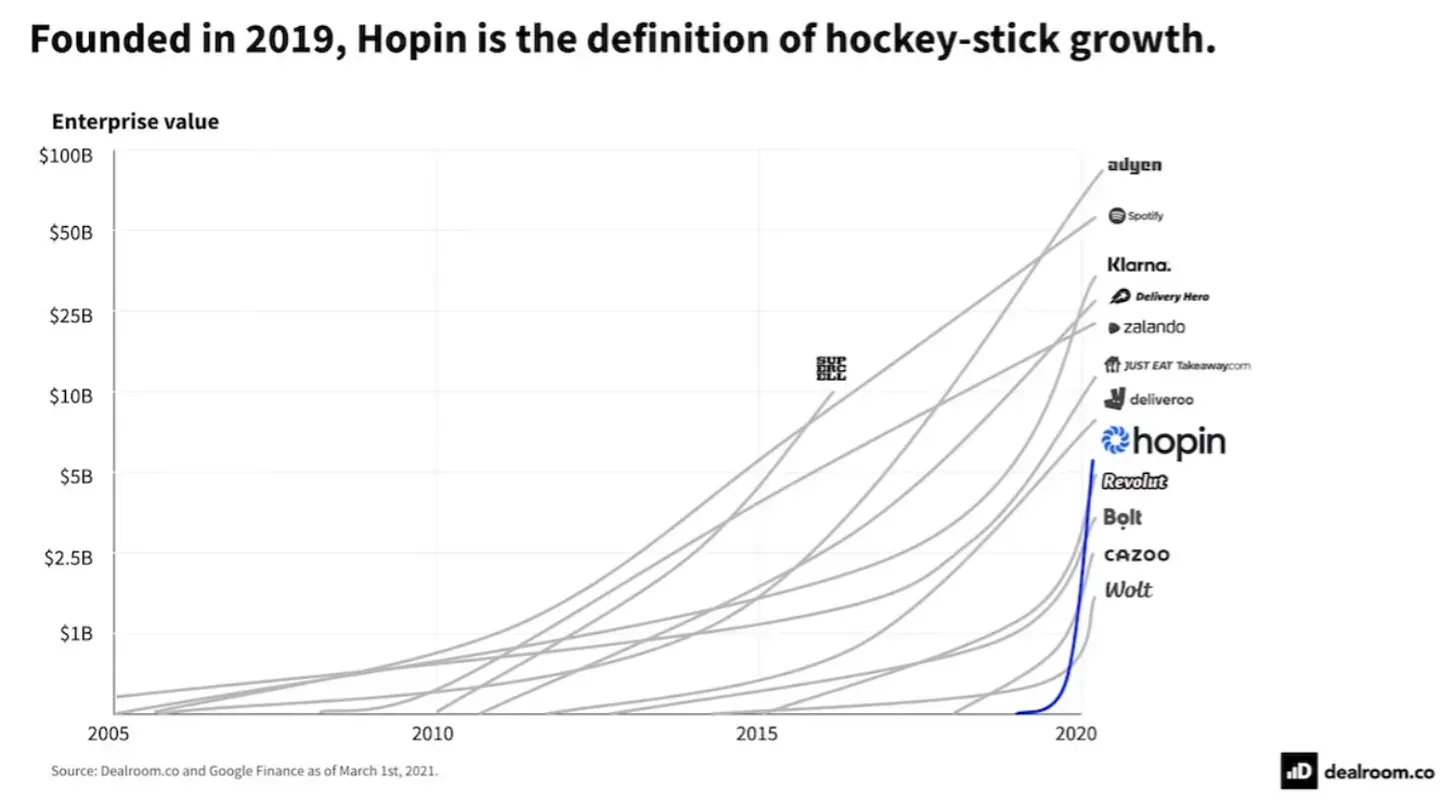
In 2020, Hopin was known as the fastest-ever growing startup in Europe by valuation. This visualization by Sifted went viral, and was widely shared by Hopin staff on social media:
Hopin’s current value is now zero, having sold its valuable assets. But how have other, formerly fastest-growing startups in Europe performed? I visualized this:
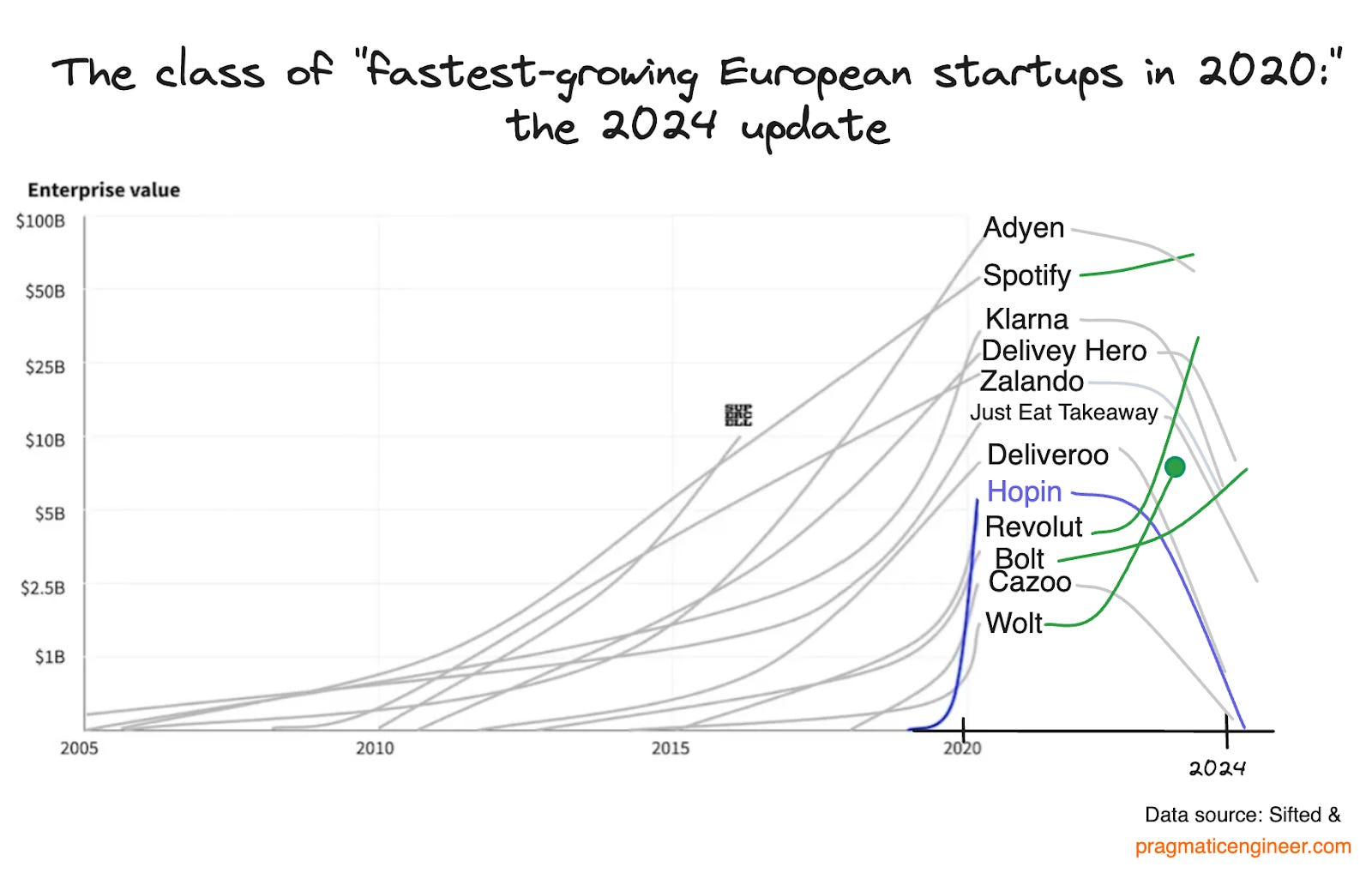
Excluding Hopin, the car sale website Cazoo did worst; it’s currently close to bankruptcy, valued at about $60M. The companies that managed to grow above than their 2020 valuations are:
- Food delivery service Wolt was acquired by DoorDash for €7B ($8.1B) in 2022
- Ride-hailing app Bolt was last valued at $8.5B, and is supposedly preparing for an IPO in 2025
- Neobank, Revolut, was valued at $33B, even though some investors cut their valuation of the company to around $20B in the summer of 2023
- Spotify’s current market cap is nearly $60B, and the company is trading close to its 2021 all-time-high
This chart confirms what we already know: 2020-2022 was a time when startup and scaleup valuations hit all-time highs, fueled by zero interest rates, and widespread changes in consumer spending caused by the Covid-19 pandemic. We have covered what the end of rock bottom rates could mean for the tech industry.
Subscribe to my weekly newsletter to get articles like this in your inbox. It's a pretty good read - and the #1 software engineering newsletter on Substack.