Hi, this is Gergely with a bonus, free issue of the Pragmatic Engineer Newsletter. In every issue, I cover Big Tech and startups through the lens of senior engineers and engineering leaders. Today, we cover one out of four topics from last week’s The Pulse issue. Full subscribers received the article below seven days ago. If you’ve been forwarded this email, you can subscribe here.
Two months ago, I asked why Meta appeared intent on destroying its engineering organization, at a time when the social media giant was reporting record revenue and profits. The question was raised after the company did two unexpected things:
- Laid off 10% of staff. Executed large layoffs in May, with circa 10% of engineers shown the door.
- Moved 20-30% of engineers to AI training. At around the same time, infra and product teams lost a further 20-30% of their engineers, who were reassigned to data labeling work for AI training.
The outcome of that period was low morale and a string of embarrassing outages, including a “zero auth password reset” outage on Instagram, where anyone’s account – including that of former US president Barack Obama – could be taken over just by asking the AI bot to replace Obama’s email with a different one.
Now, thanks to reporting by Reuters, new details have emerged about a plan for much larger layoffs, which eventually did not go ahead. The news report is pretty damning, and I want to get into what the planned AI job cuts reveal about Meta at this point in its history, what Zuckerberg might have been thinking, and what it could mean for other tech companies.
Making Meta “AI-native:” Project Organization Transformation
The plan was formed in January of this year. As per Reuters:
“In January, Meta CEO Mark Zuckerberg and his top lieutenants gathered for their annual leadership retreat at his Hawaii compound. There they hatched a radical plan to reimagine work at the social-media giant in the age of artificial intelligence.
Code-named Project OT – short for Organization Transformation – the plan envisioned an “AI native” future for the owner of Facebook and Instagram. AI would take over much of the daily work performed by thousands of human employees. Virtual workers would be overseen inside Meta by smaller, “talent-dense” cadres of human staffers, according to one internal planning document reviewed by Reuters and three people familiar with the project.”
The idea was that many existing teams could be reduced by 60% in their size through layoffs and reallocation of workers to other parts of the business. Underpinning this was the assumption that AI would enable these smaller teams to operate as well as before. HR at the social media giant projected that the project would involve a bigger layoff than happened in 2022-2023, when 25% of staff were let go. The new plan was to do one layoff+restructuring in May, and another in November.
I suspect a 30-40% company-wide layoff was planned.
But at the last minute, something changed. From Reuters (emphasis mine):
“But on the night of May 19, just hours before the first layoff wave, Zuckerberg blinked. Meta laid off 10% of its employees the next day, but it called off planning for the November cuts, according to one internal document reviewed by Reuters.
By then, Meta employees were in open revolt, convinced that the company’s AI transformation initiatives were partly aimed at replacing them.”
The Reuters report shows those employees were right: Meta’s AI initiatives were indeed aimed at laying off as many of them as possible, without changing overall productivity!
Even though these 60% cuts did not happen, some teams had 30-40% cuts and struggled to cope with their workloads. It also didn’t help that I talked with teams whose key engineers got reassigned to AI labeling: those were devs with critical domain knowledge that was lost after they left.
Why did Meta want 60% smaller teams?
You must assume that a company like Meta acts rationally overall, and on that basis it’s worth figuring out what the rationale might be in the case of ‘Project OT’. The article offers a hint: executives at the company had been captivated by “AI-native” businesses in Asia, Reuters claimed:
“Meta executives, including Chief Data Officer Alex Schultz and Head of Product Naomi Gleit, visited Asia last year and admired how startups there had built their organizational charts around AI, according to three people familiar with the trips. Meta executives also commissioned their own research into how AI startups were organized and set up pilot projects to determine what being “AI native” would mean at the company, according to one source familiar with the research and internal documents describing the pilots.”
And indeed, in February Meta experimented with “AI-native pods” as reported in The Pulse at the time. The presentation obtained by Reuters shows leadership intended to achieve 60% reductions in team size with small, 3-5 person, “AI-native” teams doing the work of what had been between 10 and 20 people:
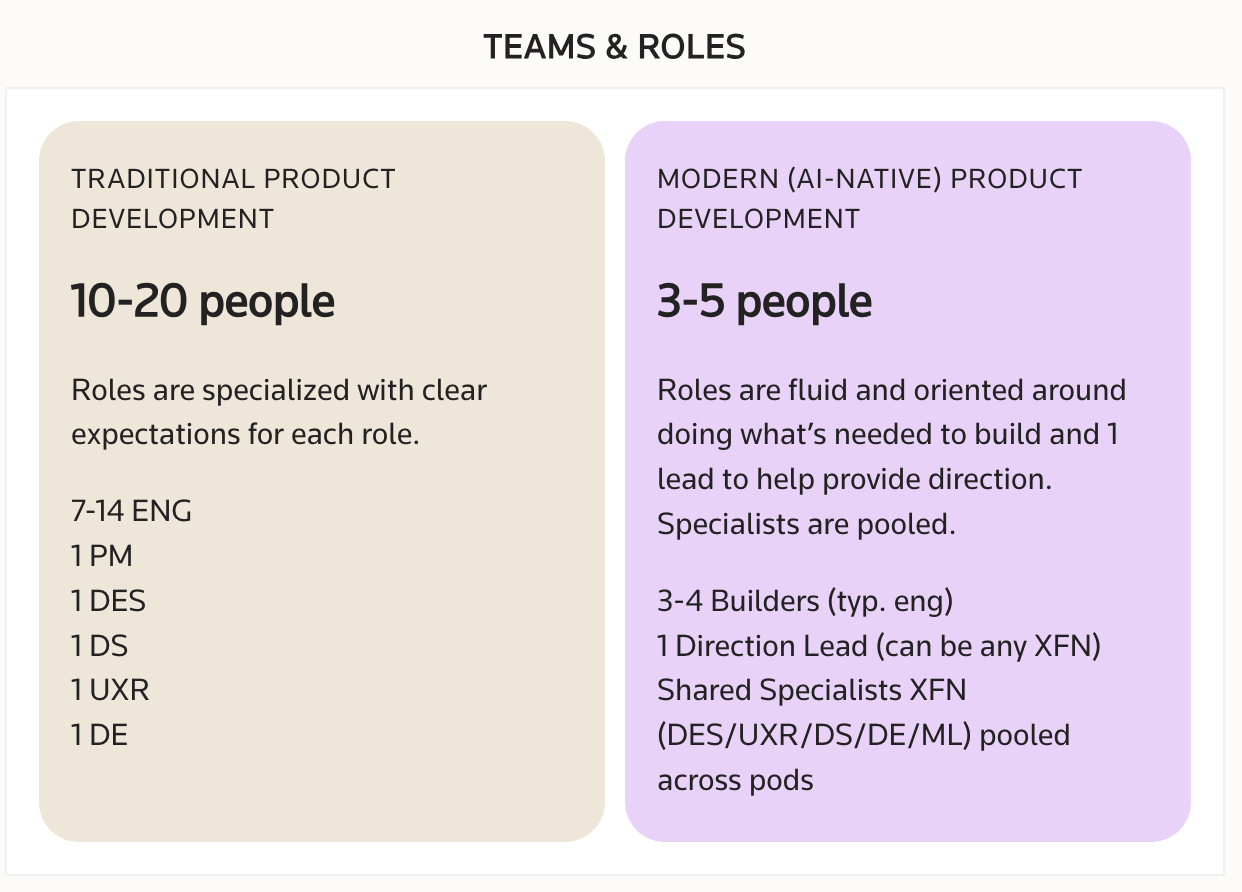
And Meta is probably on the money that engineering teams are becoming a lot smaller at startups – and “AI-native companies” are also getting smaller, by size. But those are companies that are growing slower, without ever having done mass layoffs. Meanwhile, Meta seems to have wanted to become smaller not organically, and over time, but with a brutal layoff and sudden reassignments, in the span of a year, ignoring the impact such a sudden change would have on the company, teams, and employees.
Downsides of tiny teams
In theory, a smaller team could work better with less communication overhead and quicker decision-making, so there are cases where the upsides of a small team outweigh the downsides. For example, if there’s a small team of very senior folks with sound judgment skills, outstanding domain knowledge, and who don’t care about growing professionally anymore. However, such expected gains would come with several real costs, mostly associated with losing so much experience and skill:
- Domain knowledge: A lot of personal domain knowledge is suddenly gone.
- Redundancy: what if someone is on vacation, another is sick, and the other has an urgent appointment that cannot be moved? In a 10-20 person team, it would mean business pretty much as usual. But in a 3-5 person team, you’re down to two people doing everything!
- Capacity for oncall: a healthy oncall schedule needs 6+ engineers if every alert is to be taken seriously by an engineer whose main focus is oncall and systems stability.
- Lack of “slack time”: Innovation often comes from having time to focus on other work, instead of putting out fires. A bigger team naturally creates more “slack time” that can be used for other things, like university recruiting events, writing engineering blog posts, working with other teams on building things together, etc. In contrast, one that’s stretched thin with a maximum of 5 people or less gets almost zero slack time.
- Professional growth: engineers pair with more devs and get more feedback on larger teams. There’s more discussion and generally more opportunities to learn.
- Judgment: For honing one’s skills, there’s more experience and mentoring to be gained in larger teams than on small, “AI-native” ones where engineers spend the most time with AI. How good is AI’s judgment, anyway?
Is Zuckerberg’s worst fear being out-executed by a startup?
With Meta’s business posting record revenue and profits, and facing zero pressure to radically change how the social media giant operates, it’s worth asking why the social media giant was in a rush to get to 60% smaller teams. It would be a significant challenge for the 75,000-strong company, unlike for some small startups with under 100 people.
My hunch is that Mark Zuckerberg is paranoid about a startup which executes better and that could “destroy” Meta at some point. After all, this is exactly what Facebook did, back in the day. In 2008, Myspace was the king of social networks and Facebook was only a small player – yet three years later, Myspace’s usership had collapsed. The Huffington Post analyzed the collapse (emphasis mine) at the time:
“Just over three years ago, in the spring of 2008, Myspace was top dog. That April, the upstart Facebook grabbed the lead and never looked back. In those three years, Myspace has lost over forty million unique visitors per month, lost both co-founders, laid off the vast majority of its staff and more generally, has diminished to a cluttered afterthought of the power it once was.
In an interview with Businessweek, former founder Chris DeWolfe blamed Myspace’s overenthusiasm and underexecution on the product side for many of the site’s problems.
“We tried to create every feature in the world and said, ‘okay, we can do it, why should we let a third party do it?’” said DeWolfe. “We should have picked five to ten key features that we totally focused on and let other people innovate on everything else.”
Instead, Myspace unleashed a slew of products that were buggy and dysfunctional and confusing and alienating to users, and which couldn’t keep pace with Facebook’s own progress.
“[Myspace failed] to execute the product development,” former Facebook president, Sean Parker, said in a recent interview. “They weren’t successful in iterating and evolving the product enough, it was basically this junk heap of bad design that persisted for many, many years. There was a period of time where, if they had just copied Facebook rapidly, I think they would have been Facebook. The network effects, the scale effects were enormous. There was so much power there.”
Ironically, Myspace’s desperate attempts to recoup its former success came in the form of imitating Facebook, a site it’d once tried to set itself apart from. It adopted the news feed Facebook had popularized, and neatened up the site itself in a way that also suggested it was taking visual cues from Zuckerberg’s page. In November 2010, the site integrated with Facebook Connect, calling it “Mashup with Facebook.”
Myspace had twice as many employees as Facebook (around 800 at the time), and grew faster than Facebook in 2003-2007. But Facebook out-executed Myspace by being more nimble and more focused. Zuck’s business has seemed to try and be like a startup in its nimbleness of execution since then, not wanting to give anyone the chance to disrupt it like it did to Myspace.
If so, is Zuckerberg being paranoid about a similar threat to Meta today? Myspace was far from being the decades-old company that Meta has become! It was only founded six months before Facebook and got more traction in its early years, but fumbled execution as it grew. In contrast, Meta is today the tenth largest publicly traded company by market capitalization in the world, with a $1.4T valuation.
Then again, maybe there’s cause for Zuckerberg to be paranoid: Anthropic, only five years old, with one twentieth of the workforce Meta has, and might be going public at a close to $2T valuation as soon as October. Anthropic is not a direct competitor to Meta – it’s not a social media company – but Zuckerberg clearly sees AI companies as a form of competition to Meta’s business model. After all, every minute a person spends chatting with an AI chatbot like ChatGPT, they’re not spending it on Instagram, Facebook or WhatsApp.
Maybe this is one reason for the forced reallocation of 20-30% of software engineers to do data labeling and other training tasks on Meta’s AI model. To Meta’s credit, Muse Spark is a pretty capable model, and while it is behind the likes of GPT-5.6 and Opus 5, it’s already ahead of Google’s AI models – no small feat!
Most valuable assets: people or GPUs?
Let’s consider how Zuckerberg might respond if he perceives these things:
- Smaller teams execute better with AI
- These smaller teams can out-execute Meta: like Anthropic has done with AI model development
- There’s a danger that Anthropic and OpenAI could do with Meta, like Facebook did with Myspace
One approach would be to lay off 20-40% of the workforce, but there are consequences:
- Workers reject being treated like “cattle”. Meta’s “Project Organization Transformation” assumed that productivity would go up if teams greatly shrank and used AI tools. But would this happen? When people realize 60% of their colleagues were reassigned or let go because of AI, they might look further ahead: will another 60% be laid off at some point for the same reasons? Work could start to resemble the “Hunger Games”, where people have job security only until the next model release.
- Engineering is officially a cost center, not a profit center. We previously covered how most tech companies treat engineering as a “profit center” that generates revenue, and is therefore worth investing in. At such companies, engineers are treated well; not just financially, but in how leadership treats them as a key part of the business. At Meta, software engineering became a cost center pretty much overnight!
- Mission, what mission? People often join a company and stay motivated over time due to a mission they personally believe in. What if next year’s mission is to lay off as many people as possible, or to survive future culls? That doesn’t seem like a very inspiring mission.
What makes Meta worth its $1.4T valuation, anyway? Meta generates $228B annual revenue, and $68B profit (net income). The company is valued 6x its annual revenue and 20x its annual profit because investors bet its revenue and profits will continue to rise. But how does this happen? It’s via advertising, innovation, and launching new products.
How do you promote and enable the innovation which creates the products of tomorrow? “AI-pilled” folks might look to the technology as it gets more capable. But AI-native companies which can innovate will achieve results faster, putting Meta behind the likes of Anthropic, OpenAI, and SpaceX.
Or you develop a smaller workforce full of entrepreneurs and innovators, who will invent these new approaches and products. Basically, the best employees need to be motivated to stick around longer term.
That’s the problem with large layoffs; they prompt precisely the best employees to quit to join competitors, or launch their own businesses. This happened with Meta’s previous layoffs, as covered two weeks ago in ‘Meta’s self-inflicted resignation wave’. When leadership declares the ‘bottom’ 20-40% of the workforce is redundant, then very few people feel safe, and key members of Meta’s engineering organization will get offers from AI labs and Big Tech rivals. This is the “resignation wave” in action, all started by May’s layoffs and forced reassignments.
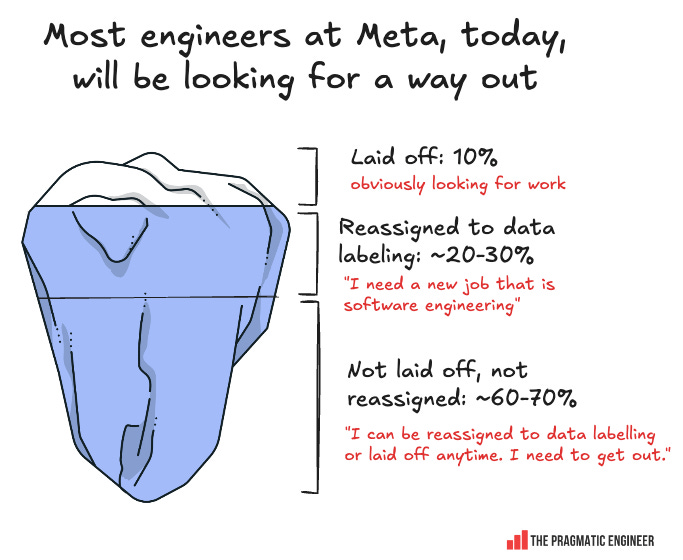
Knowingly or not, Meta creates an internal “mercenary” culture, where more of the people who stay are in it for the money and little else. Everyone knows they could well be laid off at any time the AI becomes good enough to replace them. People cannot control whether they end up on a list of positions to be cut, so it’s sensible to just make as much money as possible while awaiting the seemingly inevitable. That sounds like a pretty miserable place to work.
It could also lead to a situation where the workforce becomes more populated by those with no better options, who are not in demand from other companies.
Do social impacts matter to Meta?
A final element of the planned drastic job cuts, as revealed in the Reuters report, that I want to touch on is the potential wider, external impacts. Honestly, I’m surprised that none of Meta’s leadership seems to have considered this angle.
By executing massive layoffs for the sake of AI, Meta could have invited more regulation of the emerging AI sector. Meta is one of the largest tech employers in the US, and the CEOs of Anthropic and OpenAI are on record for predicting mass unemployment, and calling on governmental intervention should it happen. In fairness, other tech companies have also held major AI-related layoffs; Block let go 40% of its workforce, about 4,000 people in February.
But Meta is not just another tech company: it’s the world’s leading social media company, and just lost a major US lawsuit alleging that its platforms harm children and faces an $18B fine. As a result, it has committed to make its platforms less addictive. If the planned cuts had happened at Meta and all those staff became unemployed, how would it have dealt with complying with the court’s ruling to make its products safer for children? Could AI be relied on to deliver this with much less human input?
In light of the recent legal defeat, it wouldn’t be a good look for Zuckerberg’s company to blatantly put profits ahead of people by dismissing a load more workers. The combined effect of the two events would create terrible optics. In response, the government could decide that Anthropic’s and OpenAI’s CEOs were right about the threat to society of mass job losses and roll out things like:
- Stricter employee protection, specifically around AI-related layoffs.
- Higher taxation on profits of companies that “replace” staff with AI, and channel the revenue to deal with widespread whitecollar unemployment
- Start taxing AI at source whenever tokens are sold, and use the surplus to counter the social ills of unemployment
Or the government could do nothing and leave it to the market to deal with unemployed whitecollar workers by creating enough new companies to employ highly-skilled software engineers, PMs, designers and other folks.
Overall, the canceled plan to cut thousands more jobs in this climate just adds to the feeling that there are no adults running Meta. Since Sheryl Sandberg quit in 2022 as Chief Operating Officer and Zuckerberg’s “right hand”, Meta has acted irrationally, irresponsibly, and unpredictably:
- 2022-2023: laying off 25% of staff
- 2024-2025: immediately rehired even more people so that 2025’s headcount returned to 2022 levels, raising the question of what the point of layoffs even was
- 2026: on track to overtake Google as #1 in advertising revenue this year
- May 2026: conducted sudden layoffs and forced reassignments of engineers, while aiming to replace as many devs with AI as possible for no obvious reasons like external pressure or competitive threats.
I’ve long had a generally positive view of Meta’s engineering culture, but with the company’s leadership seemingly worshiping AI and holding their colleagues in disdain, you have to wonder which software engineer would choose to work at Meta if other options are available. There are many tech companies that value their human software engineers, understand that great teams make for great companies, and that AI is a tool and not a replacement for human energy, motivation, and thoughtfulness. But Meta is clearly not among them.
Read the full issue of last week’s The Pulse, or check out this week’s The Pulse. This week’s issue covers:
- New trend: tech companies moving to open models. Uber, Pinterest, Stripe, Coinbase, Ramp, and AT&T are making large savings on their AI bills by dropping proprietary models and using smart model routing.
- Automatic software maintenance experiments by Linear and Anthropic. Both startups are experimenting with how far they can push AI agents to automatically fix bugs and remove tech debt. It’s working better than anyone might’ve expected in the recent past, but not producing code that can be merged without review.
- Frontier AI lab wars: OpenAI pulls models from SpaceX / Cursor. With SpaceX now a frontier model and rival to OpenAI and Anthropic, OpenAI has pulled its GPT models from Cursor. This isn’t an option for Anthropic which is dependent on the SpaceX compute they rent to serve Claude.
- HR tech startup’s one-dev-per-project approach. A full-remote HR startup with 70 engineers has a single engineer run each project, and says the approach works well. Will this approach be adopted elsewhere, especially at other full-remote startups?
- Industry Pulse. Meta moved over to Slack for better agent interoperability, layoffs at Uber and PagerDuty, Anthropic upsets users by calling a rate limit decrease an “increase”, token usage explodes on OpenRouter, AI drives surging demand for Apple’s Mac Mini & Mac Studio, and more.
Subscribe to my weekly newsletter to get articles like this in your inbox. It's a pretty good read - and the #1 software engineering newsletter on Substack.